

The Brain Learns the Emotional “Music” of Childhood
Yesterday, I had a strange realization while staring at the little face emojis on my iPhone.
I was trying to pick one to accompany a text and having a hard time picking. The half-smile. The sideways eyes. The tight mouth. The little grimace. Where they what I was trying to relay?
And suddenly it clicked.
Those tiny pictures are basically instruction manuals for how many humans move their faces to signal emotions to each other.
And here’s the part that made me laugh at myself a little: I’ve been using face emojis wrong my whole life.
I didn’t realize they were meant to correspond to specific emotional signals.
I just picked the ones that I felt drawn to in the moment.
Somehow I had the impression that the ambiguity was part of the fun. Like picking a little decorative flourish at the end of a sentence. A vibe marker. A punctuation mark with personality.
Apparently, that’s not what most people are doing?
I think, if I have this decoded properly, most people are using those faces because they represent specific emotional expressions — little diagrams of what human faces do when they’re communicating things like:
I’m friendly.
I’m joking.
I’m embarrassed.
I’m uncomfortable.
I hear you.
Everything is okay.
If you’re autistic and reading this, you might already know exactly what I’m talking about.
Many of us grow up studying human behavior like a puzzle — noticing patterns, memorizing rules, and slowly piecing together systems that other people seem to absorb without ever being taught.
When that clicked, something else clicked too.
Those emojis aren’t just cute symbols and I’ve been using them “wrong” from a communication stand point.
They’re simplified versions of a communication system humans use constantly — facial expressions.
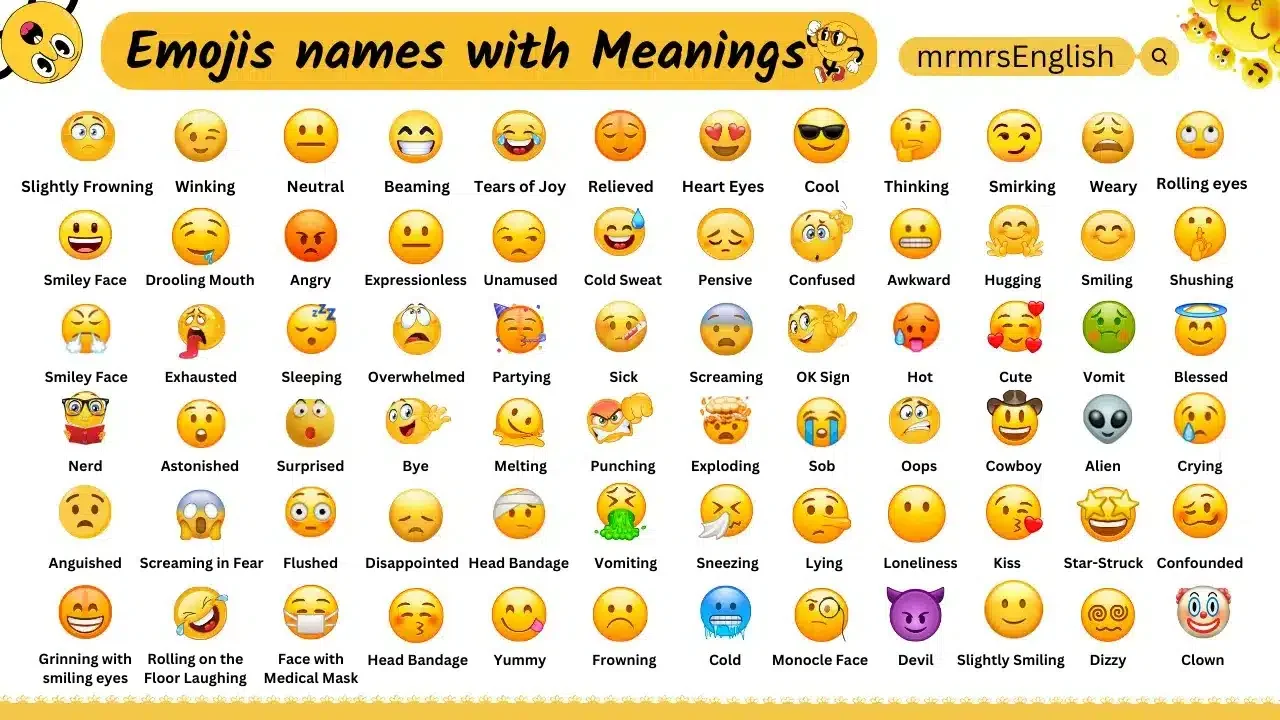
I found this online. I mean, great. Also, what emotion is slightly smiling? Melting?” Flushed?” Expressionless,” “Unamused” (I don’t even know what that means).
Most people don’t consciously think about this system. Their brains learned it automatically when they were little. They just feel what someone’s face means.
But as an autistic adult, that isn’t how my brain learned it.
In fact, something dawned on me today that feels almost embarrassing to admit: I didn’t realize that people were intentionally using their faces to communicate emotional information all the time.
Of course I knew that faces change when people feel things. Everyone knows that. Also, I’ve been using the prayer hands to mean “I hear you,” “I' support that idea,”, “my heart is with you,” “preach,” etc
I hadn’t fully understood that facial expressions are also a communication system — that people are constantly sending little signals with their faces on purpose.
Things like:
softening their face to show kindness
smiling to signal friendliness
raising their eyebrows to show interest
tightening their mouth to show discomfort
widening their eyes to signal surprise
And the other part that hit me just as hard was this:
I didn’t realize that I could use my own face to intentionally communicate how I feel.
Looking at emojis made something suddenly visible to me that had been invisible before.
Those little cartoon faces exaggerate the signals that human faces make. They strip the system down to simple shapes:
a curved mouth means warmth
wide eyes signal surprise
a tilted eyebrow signals skepticism
tight lips signal tension
FYI: I got the information from the internet and need to spend some time memorizing it because it still feels clunky and unnatural in my head.
For a moment it felt like I was looking at a visual guide to a language I had been surrounded by my entire life but never explicitly taught.
Most people seem to learn this language automatically in childhood.
But many autistic people don’t absorb it the same way.
Like many autistic adults, I’ve spent much of my life studying human behavior almost the way someone studies a foreign language. The signals that many people pick up intuitively often arrive in my brain more like patterns to analyze than instincts to follow.
For many autistic adults, moments like this happen throughout life — small realizations where an invisible social rule suddenly becomes visible.
Looking at emojis today made me realize just how much emotional information is constantly being transmitted through faces.
That realization made me curious about something bigger: how do our brains actually learn emotional signals in the first place?
On to the Science: The Brain Starts With Too Many Connections
When babies are born, their brains are full of possibilities.
In fact, babies have far more neural connections than they will ultimately keep.
Early childhood is a time of enormous brain growth. Neurons connect to each other at an incredible rate, building networks that allow us to move, speak, think, and understand other people.
But the brain doesn’t keep all of those connections.
Instead, it gradually strengthens the ones that get used the most and removes the ones that don’t. This process is sometimes called synaptic pruning.
There’s a famous rule in neuroscience that helps explain it:
Neurons that fire together wire together.
When certain experiences repeat over and over again, the pathways involved become stronger and faster. The brain essentially becomes very good at recognizing the patterns it encounters most often.
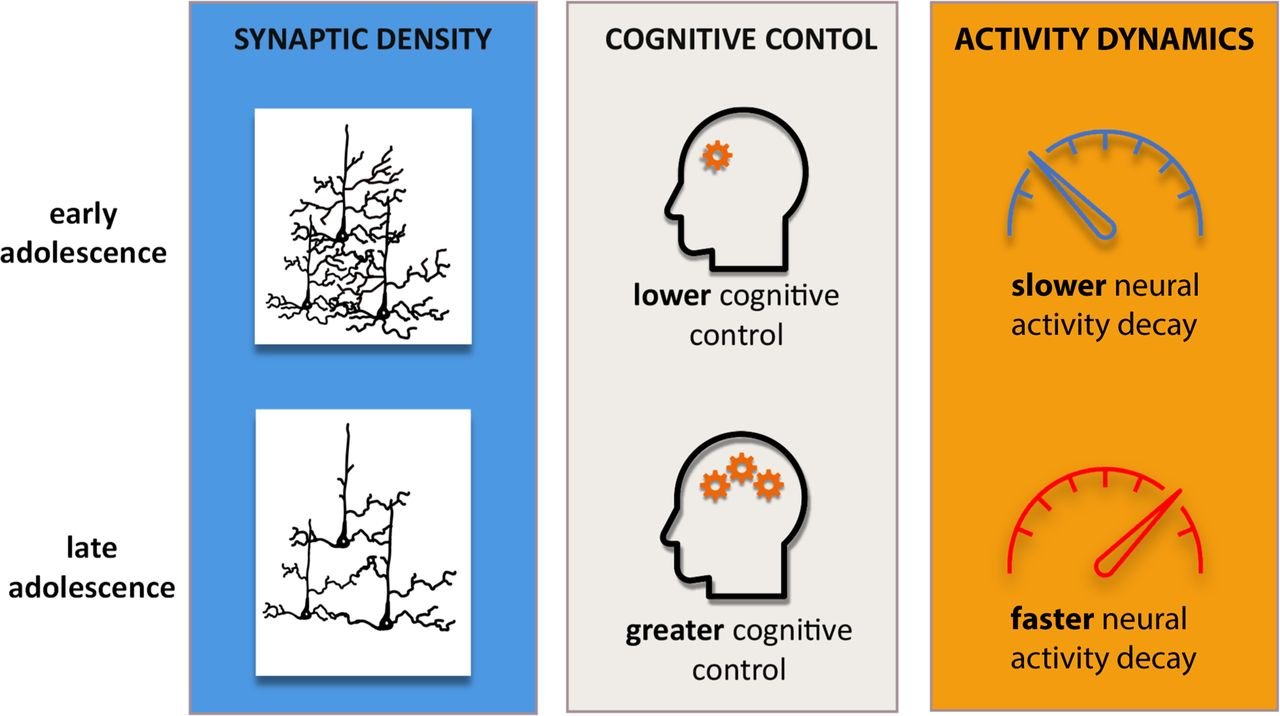
“Normal” Synaptic Pruning . Autistic brains do not fully embrace this neurological process.
Source: Fleming, L. L. (2024). Cognitive Control and Neural Activity during Human Development: Evidence for Synaptic Pruning. The Journal of Neuroscience, 44(26), e0373242024.
Emotional Signals Are One of the First Patterns the Brain Learns
One of the brain’s most important jobs in childhood is figuring out what kind of world it lives in.
Is the environment predictable or chaotic?
Are the adults calm or volatile?
Do faces usually signal warmth, anger, disappointment, or safety?
A small structure deep in the brain called the amygdala helps scan faces, voices, and body language for emotional meaning.
It’s constantly asking questions like:
Is this safe?
Is this dangerous?
Do I need to prepare to respond?
Over time, the brain becomes extremely efficient at detecting the emotional cues that show up most often.
If calm, reassuring faces are common, the brain becomes highly tuned to recognize safety.
If anger or unpredictability appears frequently, the brain becomes very skilled at detecting those signals quickly.
This isn’t a mistake. It’s the brain doing exactly what evolution designed it to do: learning the patterns of its environment so it can respond quickly.
Autism Adds Another Layer
For autistic people, there can be another layer to this process.
Many autistic brains process social signals a little differently. Facial expressions, tone of voice, and subtle social cues may not automatically register as emotional meaning the way they do for many non-autistic people.
That doesn’t mean autistic people lack empathy or awareness — something I’ve spent much of my career helping people understand.
It often just means the brain approaches social information more analytically and less automatically.
Instead of intuitively absorbing every facial cue, the brain may build understanding through observation, pattern recognition, and experience.
In some ways, it’s like learning a language through grammar and structure rather than through immersion alone.
Which may explain why it took a handful of cartoon emoji faces for me to suddenly realize that human faces are constantly broadcasting emotional information — and that I had the ability to broadcast some of my own as well.
Why This Matters
Understanding how early experiences shape the brain can change the way we think about anxiety, hypervigilance, and social perception.
Many people assume that anxiety means something is wrong with the brain.
But very often, what’s actually happening is that the brain became very skilled at detecting the signals it needed to watch for in earlier environments.
The system is working exactly the way it was trained to work.
It’s simply very well practiced at hearing certain emotional notes.
Which brings me to the metaphor that came to me after all of this clicked.
Childhood tunes the emotional brain the way a musician tunes a guitar.
Whatever emotional notes were played most often in the room are the ones the nervous system learns to hear first.
Childhood tunes the emotional brain the way a musician tunes a guitar.
Whatever emotional notes were played most often in the room are the ones the nervous system learns to hear first.
