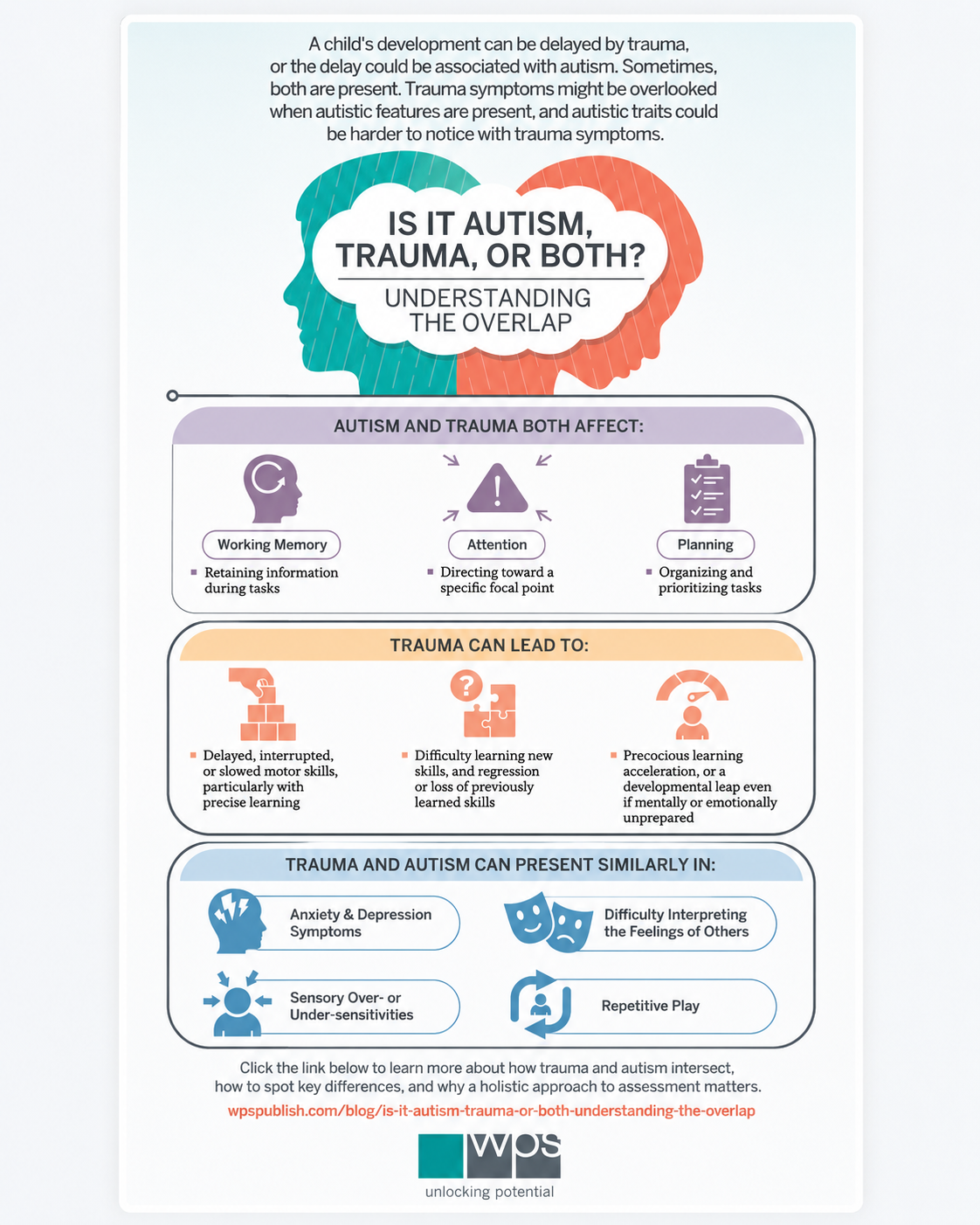
Is It Autism, Trauma, or Both?Understanding the Overlap
Autism and trauma are not the same thing, but from the outside they can sometimes look surprisingly similar. And, of course, an autistic person can also experience trauma.
That overlap matters because it can make it harder for parents, autistic people, and even professionals to understand where a particular difficulty is coming from. Trauma symptoms may be attributed to autism and missed altogether. In other situations, autistic traits may be interpreted entirely through the lens of trauma.
This article is adapted from Rebecca Stanborough’s 2024 WPS article, Is It Autism, Trauma, or Both? Part One: Understanding the Overlap.
Why can autism and trauma look alike?
Both autism and trauma can affect some of the same areas of day-to-day functioning, including:
working memory
attention and concentration
planning and organization
shifting from one activity or expectation to another
emotional regulation
impulse control
recognizing and communicating emotions
For an autistic person, many of these differences are part of their underlying neurodevelopmental profile. Trauma can also disrupt these same functions, particularly when it occurs during childhood while the brain is still developing.
That means the behavior we see does not always tell us why it is happening.
A child who cannot transition between classes, for example, may be struggling with autistic cognitive flexibility and sensory overload. Another child may become highly distressed during transitions because unpredictability has become associated with danger. An autistic child with a trauma history may be dealing with both at the same time.
Trauma can affect development
Most development builds on skills that came before it. Attention, memory, emotional regulation, motor planning, language, and social learning all contribute to a child’s ability to develop new skills.
Trauma can interfere with that process.
Following trauma, a child may:
develop certain skills more slowly
temporarily lose skills they previously had
have difficulty learning new skills
show changes in attention, sleep, behavior, or emotional regulation
sometimes develop abilities unusually quickly because circumstances required them to function beyond their developmental readiness
For parents, this is one reason developmental history matters so much. It is often helpful to ask not only “What is this child doing now?” but also “What were they like before this changed?”
For autistic adults trying to understand themselves later in life, the same question can be useful. Some characteristics may have been present from very early childhood, while others appeared or became substantially more intense following particular experiences.
Autism and trauma can share many outward signs
According to the research reviewed by Stanborough, autism and trauma exposure can both be associated with things such as:
anxiety or depression
avoidance
repetitive behavior or play
difficulty with transitions
changes in attention or concentration
emotional dysregulation
sensory over- or under-responsiveness
sleep problems
language or communication differences
reduced exploration
difficulty interpreting other people’s emotions or social cues
None of these characteristics, by themselves, tell us whether someone is autistic, traumatized, or both.
This is where oversimplified explanations become a problem. A sensory reaction is not automatically trauma. Repetitive behavior is not automatically autism. Anxiety in an autistic person should not automatically be dismissed as “just part of autism.”
Context and history matter.
Social differences can overlap too
Social communication is another area where the two can become difficult to separate.
Skills such as following another person’s gaze, sharing attention, reading facial expressions, interpreting body language, recognizing emotional cues, and figuring out complex social situations develop over time.
Autism can affect how these skills develop and how social information is processed. Trauma can also interfere with social development, particularly when relationships or environments have not felt predictable or safe.
So when someone has difficulty reading other people, making eye contact, participating socially, or knowing how to respond in an interaction, it is important not to jump immediately to one explanation.
Sometimes the answer really is “both”
Autistic people are not protected from trauma by having an autism diagnosis. Research suggests autistic children are actually at increased risk for acute stress disorder and PTSD.
This creates another diagnostic problem called diagnostic overshadowing: once autism is identified, clinicians, teachers, family members, and others may begin interpreting nearly every difficulty through that diagnosis.
A sudden increase in withdrawal, sleep problems, anxiety, behavioral changes, loss of skills, or emotional dysregulation deserves attention even when the person is already known to be autistic.
The reverse can happen as well. When someone has a significant trauma history, longstanding autistic traits may be attributed entirely to trauma, particularly when autism was not recognized in childhood.
Looking at the whole developmental picture
There usually is not one behavior that cleanly separates autism from trauma.
A thoughtful assessment looks at the pattern over time:
What was present very early in development?
Autism is neurodevelopmental, so evidence of autistic differences is generally present from early development, even if those differences were not recognized at the time.
What changed?
A noticeable change following an adverse event may point toward a trauma response layered on top of the person’s existing developmental profile.
Does it happen everywhere?
Some difficulties appear across environments, while others are strongly associated with certain people, settings, memories, sensory experiences, or situations.
What else was happening developmentally?
Language development, sensory processing, motor skills, executive functioning, relationships, family history, culture, and previous developmental milestones all provide useful information.
The goal should not simply be to decide which diagnostic box best explains a person. The goal is to understand what is driving the difficulty well enough to provide the right support.
For some people the answer will be autism.
For some it will be trauma.
And for many autistic people, the most accurate answer may be both.
Source
Adapted for a general audience from:
Stanborough, R. (2024, March 13). Is It Autism, Trauma, or Both? Part One: Understanding the Overlap. Western Psychological Services (WPS).